
REMOTE MONITORING OF SOLAR POWER PLANTS
SUMMARY
Global political and economic initiatives are driving the demand for alternative power sources. Solar power has been the leader amongst other renewable energy sources and according to IEA will dominate growth in the next five years. With significant economic powers, such as India, China, and the EU, focusing heavily on the expansion of renewable energy, solar power will undoubtedly become one of the primary energy sources of the future.
CHALLENGE
The solar power plant consists of a sophisticated infrastructure working in perfect sync to maximize the potential electricity production. Primary components are solar panels, inverters, solar controllers and transmission or energy storage systems. The performance of solar power plants must be closely monitored to ensure the maximum productivity and availability to make sure that everything is running smoothly and the electricity generation rate is within acceptable values to satisfy project ROI* schedule. Besides, remote monitoring is essential to scheduled maintenance, such as part replacement or solar panel cleaning, required for the power plant to maximize long term performance. Solar power plants are mostly located in remote areas because of the large amount of land area they occupy. Remote location poses a challenge for remote monitoring connectivity because wired Internet sources are rarely available at solar power production plant locations.
SOLUTION
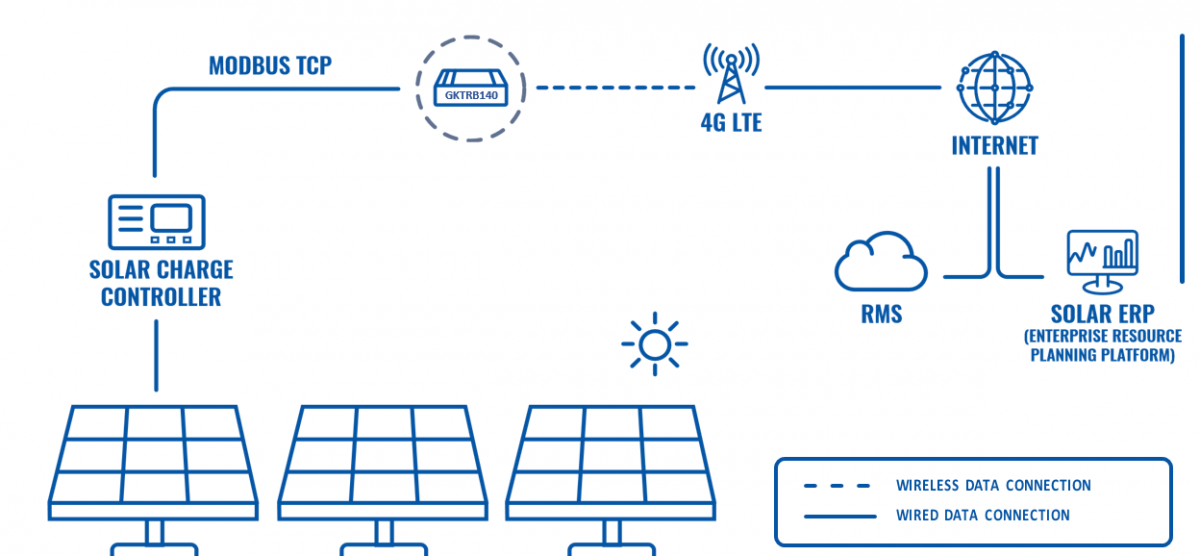
The topology above outlines a simplified classic remote monitoring solution with a cellular connectivity device at its core. The Solar controller is a brain of solar power plant operation and is generally capable of outputting system data via industrial protocols, such as Modbus TCP. Depending on the size of the solar power plant, numerous solar charge controllers are set-up to track electricity generation data from a set of solar panels. The best way to interpret this data is to use a cloud IoT platform where the data is aggregated and presented to the operator with performance metrics and suggested maintenance insights. GKTRB140 is a popular choice for this use case because of its secure and reliable cellular connectivity via 4G LTE and easy to use user interface, which requires no specialized training. Moreover, GKTRB140 includes advanced RutOS features, such as multiple VPN services, industrial, networking, & remote management protocols (Modbus TCP, MQTT and more.).
BENEFITS
- Easy to scale – you can configure infinite number of GKTRB140 in minutes using GeoKall Remote Management System (RMS).• Low-power – GKTRB140 uses only 2W of power when transferring data at maximum speeds and only 0.4 W when idle with an active data connection.
- Easy management – with GeoKall RMS you can keep all GKTRBs up to date with the newest firmware and conveniently monitor and control the gateways from anywhere – even without Public IP!
- Industrial design – GKTRB140 has a strong aluminium casing, wide range of supported power supply voltage (9-30 VDC) and a wide operating temperature range of -40 °C to 75 °C making it an ideal choice even in most challenging environments.
WHY GeoKall?
GeoKall Networks continuously focus on developing critical-mission connectivity hardware that is secure, reliable and easy to use. GKTRB140 is a simple yet powerful cellular gateway embedded with our experience and is capable of addressing all connectivity challenges in solar energy generation projects.